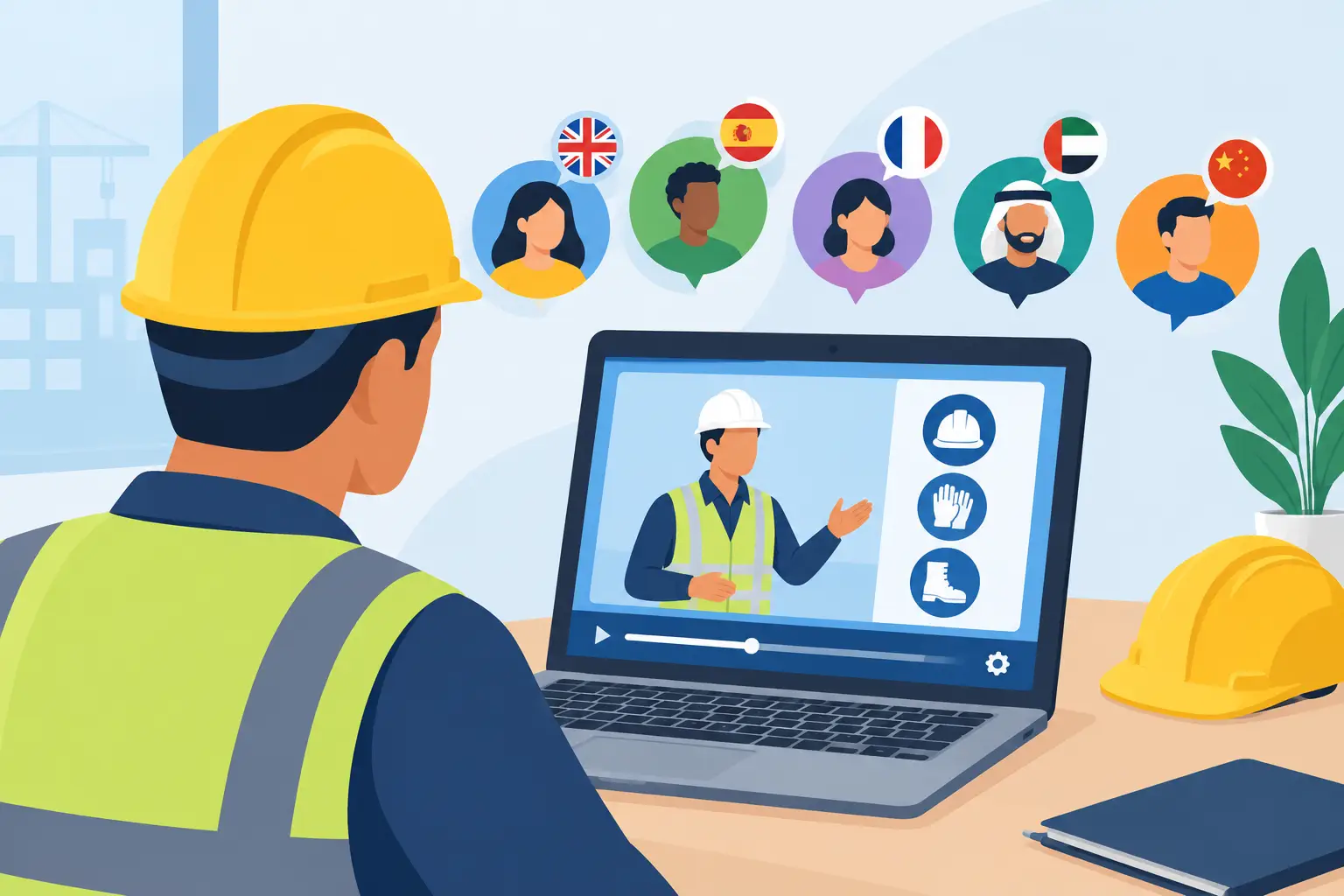
A safety briefing can be technically correct and still fail on site. If a worker cannot follow the instruction, recognize the hazard, or recall the required action under pressure, the training has not done its job. Multilingual HSE training videos address that gap by putting critical safety information in the languages frontline teams actually understand.
For organizations across construction, manufacturing, logistics, healthcare, FMCG, and other safety-sensitive sectors, this is not a communication preference. It is an operational requirement. A workforce may share one site, one set of procedures, and one safety standard while speaking Arabic, English, Hindi, Malayalam, Urdu, Tagalog, or other languages at home and at work. Training has to work across that reality.
Why multilingual HSE training videos matter
Most HSE failures do not start with a missing policy. They start when a policy is delivered in a way people cannot use. Long presentations, dense manuals, generic stock footage, and a single or boring voice-over can create a record that training was assigned. They do not necessarily create understanding.
Video is useful because it shows the correct behavior. A worker can see how to wear PPE, isolate equipment, report a near miss, respond to a chemical spill, or move safely around mobile plant. When the narration and on-screen language are familiar, the instruction becomes easier to process and retain.
That does not mean every topic needs a separate production for every language. The right approach depends on the subject, the risk level, the workforce mix, and how often procedures change. A short induction may need Arabic, English, Hindi, and Malayalam versions. A highly specialized maintenance procedure may require fewer languages but closer technical review. The goal is not to multiply content for its own sake. It is to remove the points where misunderstanding creates exposure.
Translation is not the same as comprehension
Literal translation is one of the most common weaknesses in multilingual safety communication. HSE terminology often has no clean word-for-word equivalent, especially when it involves permits, lockout procedures, confined spaces, behavioral expectations, or legal responsibilities.
A direct translation can sound unnatural, overly formal, or unclear to a frontline audience. It may also preserve an English sentence structure that does not make sense when spoken in another language. Workers then hear the words without grasping the action required.
Good multilingual training starts with a plain-English master script. Sentences should be short. Each scene should communicate one instruction or decision. Technical terms should be used only where they are necessary, then explained in practical language. From there, qualified translators and native-language voice talent can adapt the message for real comprehension rather than simply convert text.
Visuals carry part of the meaning too. If a video says “use the designated walkway,” viewers need to see a recognizable walkway, a moving vehicle, the correct pedestrian behavior, and the consequence being prevented. This reduces dependence on language alone and helps reinforce the instruction across every version.
What effective multilingual HSE videos include
The strongest safety videos are built around the moment a worker must make a decision. They do not spend three minutes on corporate introductions before explaining what to do. They show the workplace, identify the hazard, demonstrate the required control, and make the expected behavior clear.
For most organizations, four production decisions make the difference:
- Use site-specific or sector-relevant visuals instead of generic footage that does not reflect actual conditions.
- Keep each module focused on one topic, such as PPE, working at height, fire response, manual handling, or vehicle movement.
- Match voice-over, subtitles, graphics, and assessments to the language version so instructions do not conflict.
- Involve HSE, operations, and frontline representatives in review before release.
Site-specific filming is particularly valuable for high-risk operations. Workers recognize their own access points, machinery, signage, evacuation routes, and work practices. That familiarity makes the message more credible. It also exposes inconsistencies that a generic video would miss.
Animation can be the better choice when filming creates risk, access is restricted, equipment is not available, or the training needs to show an event that should never be recreated. A well-designed 3D sequence can show a dropped-object zone, a vehicle blind spot, or the internal steps of an emergency response with far more control than a live shoot. The decision should be based on clarity, not novelty.
Keep the training short enough to be used
A 25-minute induction video may contain useful information. It may also ask too much of a new employee who is processing a new site, new colleagues, and unfamiliar rules. Attention drops. Key points get buried. Supervisors start skipping sections because production schedules are tight.
Short modules solve part of the problem. Instead of one large video, organizations can build a practical training library: a core induction followed by focused videos for task-specific hazards and refresher training. This makes content easier to update when a procedure changes and easier to assign by role.
The right length depends on the task. A two-minute video may be enough to reinforce hand protection requirements. A confined-space entry process may need more time, supporting documentation, and a supervisor-led discussion. Concise does not mean incomplete. It means removing everything that does not improve safe performance.
For multilingual audiences, pacing matters as much as duration. Voice-over should leave room for instructions to land. On-screen captions must remain visible long enough to read. Fast editing may look polished, but it can work against comprehension when viewers are watching in a second language or in a noisy induction room.
Training needs proof, not assumptions
Watching a video is not the same as demonstrating competence. For audit readiness, organizations need to know who completed training, which language version they used, whether they passed an assessment, and when their certification requires renewal.
Paper sign-in sheets are weak evidence. They can be incomplete, difficult to retrieve, and unable to show whether the person understood the material. A digital assessment process creates a clearer record, particularly when it is tied to the individual worker, job role, location, and training module.
This is where training video and learning verification need to work together. People Pulse Media pairs concise video training with PULSYON, a device-accessible onboarding and assessment platform. The video trains. The platform records completion, delivers live assessments, and provides documented proof of competency without relying on classroom paperwork.
Assessment questions should reflect real decisions, not test memory for its own sake. A worker should be able to identify the correct response to a blocked fire exit, missing guardrail, unsafe lifting practice, or spill. If several employees miss the same question, that is useful operational information. It may indicate that the video, procedure, supervision, or site controls need attention.
A practical production process for HSE teams
A dependable project begins before cameras arrive. HSE and operations teams should define the audience, languages, risk topics, site conditions, and required outcomes. They should also agree on what proof of completion is needed for internal records, client requirements, or external audits.
The script then needs a technical review. This is where vague wording is removed, steps are put in the correct sequence, and roles are clarified. A video can be visually strong and still create risk if it shows the wrong PPE, an outdated process, or an incomplete permit workflow.
After filming or animation, each language version needs its own quality check. Review the translated script, voice-over pronunciation, subtitle timing, graphics, and final assessment. Do not assume the English approval covers every version. A small error in a translated safety instruction can have a large consequence.
Finally, plan distribution before launch. Will workers view training on a phone, at an induction station, in a toolbox talk, or through a learning platform? Can they access it with limited connectivity? Who follows up on incomplete modules? A good video has limited value if the delivery process is unclear.
Measure the result where work happens
Completion rates are useful, but they are only a starting point. Look at assessment performance by language, role, contractor group, and location. Track recurring questions from supervisors. Watch whether near-miss reporting improves after a campaign or whether common unsafe behaviors reduce following targeted refreshers.
Not every change can be credited to a video alone. Safety performance is shaped by supervision, equipment, workload, signage, and workplace culture. But training should make its contribution visible. If the message is not understood, the result will show up quickly in poor assessment scores, repeated questions, and inconsistent behavior.
The most useful safety content respects the worker’s time and intelligence. Give people clear instructions in a language they understand, show them what good practice looks like, and verify that the message has been received. That is how training becomes part of safer work, rather than another item checked off before the shift begins.