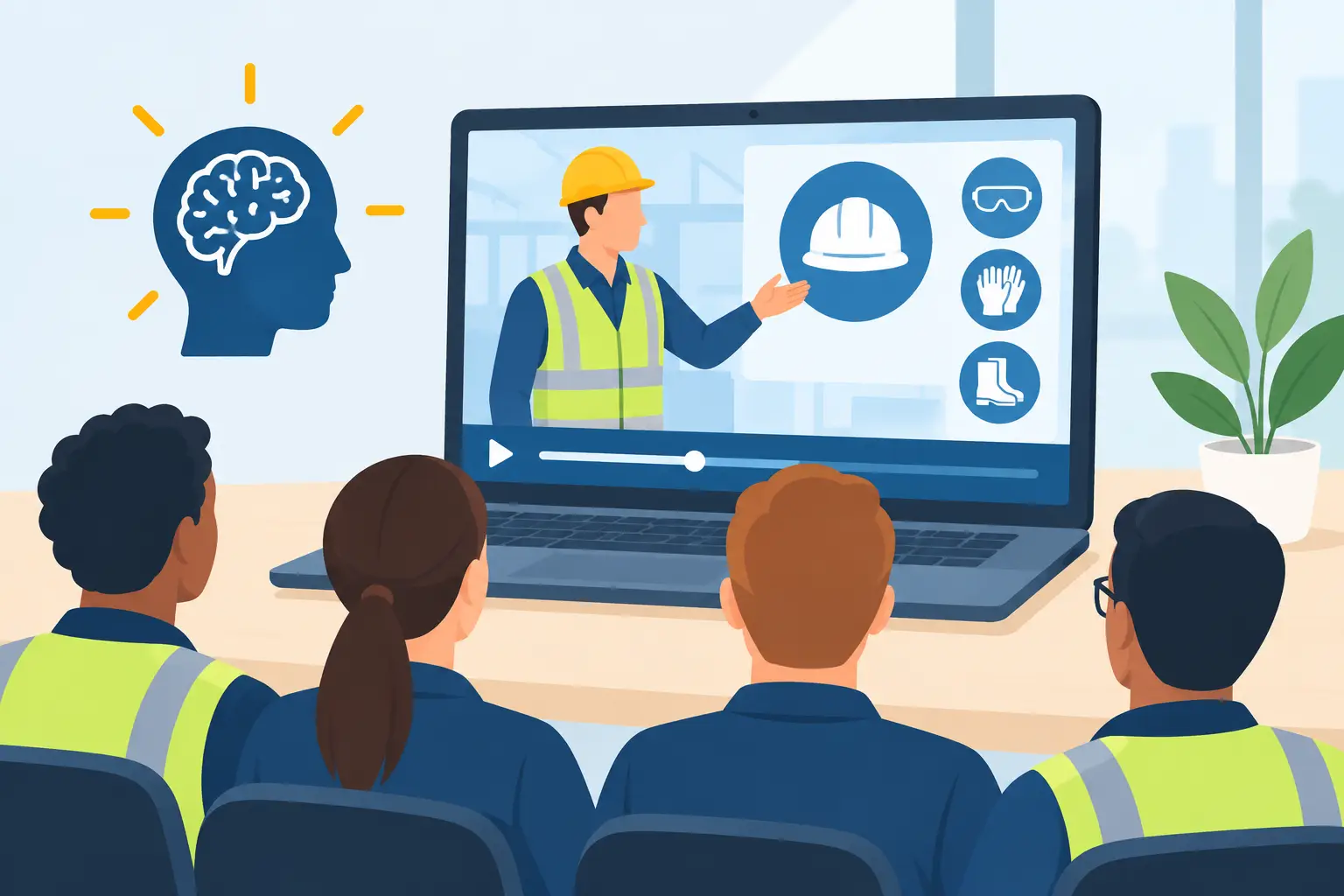
A worker standing beside a live machine does not need a 25-minute presentation on policy language. They need to know what to check, what can go wrong, and what action to take before work begins. That is the standard safety training videos must meet: clear enough to understand on the first viewing and practical enough to use on the job.
For HSE, HR, and operations leaders, the issue is rarely whether training exists. The issue is whether it changes behavior across a busy, multilingual workforce – and whether the organization can prove it did. A completion certificate alone cannot answer either question.
Why Safety Training Videos Often Fail
Many organizations inherit a library of training content that is technically correct but operationally weak. It is too long, too generic, or written for office readers rather than the people working on a site, production line, warehouse floor, or road. Employees watch it because they are required to. They retain little because the content gives them little to recognize or act on.
The first problem is abstraction. A statement such as “always follow safe lifting procedures” is not training until the viewer can see the correct stance, the load limits, the team lift decision, and the point at which they must stop. Safety communication has to turn rules into observable actions.
The second problem is language. English subtitles are not a multilingual strategy. In Gulf workplaces, teams may speak Arabic, English, Hindi, Malayalam, Urdu, Tamil, Tagalog, or other languages. If the language feels distant, the message does too. Translation also needs care: a literal script can preserve words while losing meaning, tone, and urgency.
The third problem is the missing proof loop. A video viewed on a shared screen may be useful for induction, but it does not establish individual understanding. During an audit, “we played the video” is a weak answer when the question is whether a specific person completed the required module and demonstrated competency.
What Effective Safety Training Videos Do Differently
Effective training is focused. It addresses one role, one hazard, or one work sequence at a time. Rather than explaining every possible policy in a single film, it helps workers make the right decision in the moment that matters.
Three things. Done properly. The video should show the actual risk, demonstrate the correct behavior, and confirm that the viewer understood it. Creative quality matters because poor audio, vague visuals, and slow pacing cause attention to drop. But production is not decoration. It is how a critical message becomes understandable.
Show the work as it really happens
Frontline teams recognize real environments immediately. A confined-space entry video should show the permits, gas testing, attendant role, communication method, PPE, and emergency steps used in the organization’s own operation. A forklift module should reflect real pedestrian routes, loading areas, blind corners, and battery charging procedures.
Using actual locations and equipment builds relevance and trust. It also exposes gaps before filming begins. When the script is compared with the work being done, unclear handoffs, conflicting procedures, or missing controls often become visible. That is useful. A training video should not hide operational inconsistency behind polished visuals.
There is a trade-off. Filming on a live site requires planning, permits, supervision, and careful control of production activity. Stock footage can be faster for general awareness topics, but it should not carry the full weight of site-specific instruction. The more direct the safety risk, the more value there is in showing the real task.
Use language people can act on
Plain language is not a reduction in standards. It is how standards reach the people responsible for following them. Replace broad warnings with specific direction: where to stand, what to inspect, who has authority to stop work, and what must happen before a task continues.
For multilingual delivery, build the script for adaptation from the start. Short sentences translate better. Familiar terms reduce ambiguity. Voiceovers should be delivered by speakers who sound natural in the target language, not by automated voices that flatten safety-critical instructions.
The right language mix depends on the workforce and the risk. Arabic and English may be sufficient for a management policy module. A frontline induction for construction, manufacturing, or logistics may need Hindi and Malayalam as well. The goal is not to produce every language by default. It is to remove the comprehension gap where it affects safe performance.
Keep each module short enough to use
Length is not a quality measure. In fact, long films often combine unrelated topics because it seems efficient to produce one large asset. The result is harder to update, harder to assign by role, and harder for employees to remember.
Short modules make more operational sense. A new hire can complete a structured induction path. A maintenance technician can revisit lockout/tagout before a task. A supervisor can assign a quick refresher after an incident or procedural change. When a policy changes, one module can be updated without reshooting the entire training library.
For many topics, three to seven minutes is enough. Higher-risk or complex procedures may require more time, but even then, split the content at logical decision points. The viewer should leave each section with a clear answer to one question: what do I need to do safely?
Build Training Around Roles, Not Departments
A corporate safety policy may apply to everyone, but the risks do not. A driver, laboratory technician, construction worker, customer-facing employee, and warehouse picker need different examples, instructions, and assessment questions.
Role-based learning prevents two common failures. First, people are not forced through material that does not apply to them. Second, critical instructions are less likely to be buried inside a general module. This makes training more efficient without weakening compliance.
Start by mapping roles to their required competencies. A basic matrix might separate company induction, site induction, task-specific hazards, equipment authorization, emergency response, and annual refreshers. Then identify where a video is the best format. Demonstrations, decision scenarios, and visual hazards work especially well on screen. Detailed specifications or controlled documents may still belong in written procedures.
This is where HSE, operations, and HR need to work together. HSE defines the control requirements. Operations validates how the work actually happens. HR or L&D manages onboarding and assignment. A production partner turns that knowledge into content people can follow without diluting the requirement.
Completion Is Not Competency
A video platform that records a play button click is useful, but it is not enough for every training requirement. A person can let a module run while doing something else. They can complete it in a language they do not fully understand. They can pass a basic quiz by guessing.
For lower-risk awareness training, completion records may be appropriate. For higher-risk roles, add knowledge checks that test practical decisions, not recall of isolated phrases. Show a scenario: a damaged sling, an obstructed emergency exit, a missing permit signature. Ask what the worker should do next and why.
Assessment design matters. Questions should match the actual job, use the employee’s training language, and require a meaningful pass score. If someone does not pass, the system should direct them back to the relevant section rather than simply record a failure.
People Pulse Media’s PULSYON platform applies this model through device-accessible, role-based video learning, live assessments, completion records, and audit-ready reporting. No classroom. No paperwork. The training video explains the action; the assessment helps demonstrate that it was understood.
Measure the Signals That Matter
Completion rates are a starting point, not the finish line. Review where people replay modules, which assessment questions produce incorrect answers, how long completion takes, and whether specific departments or languages show lower pass rates. These signals identify where the communication, process, or supervision may need attention.
Also connect training to field evidence. Are pre-task checks improving? Are supervisors seeing better PPE compliance? Have near-miss reports identified the same misunderstanding that appeared in assessment data? Training cannot solve every safety problem. Poor equipment, unrealistic production pressure, and inconsistent supervision need operational correction. But well-designed video can reveal where those pressures are affecting understanding.
The most useful training library is never treated as finished. Procedures change. Sites change. New risks appear. Review priority modules after incidents, audits, major workforce changes, or updates to legal and client requirements. A focused update made quickly is more valuable than a perfect film that becomes outdated.
When workers can see the task, hear the instruction in a language they trust, and prove they understand the required action, safety communication becomes part of the operation rather than another item on an induction checklist.