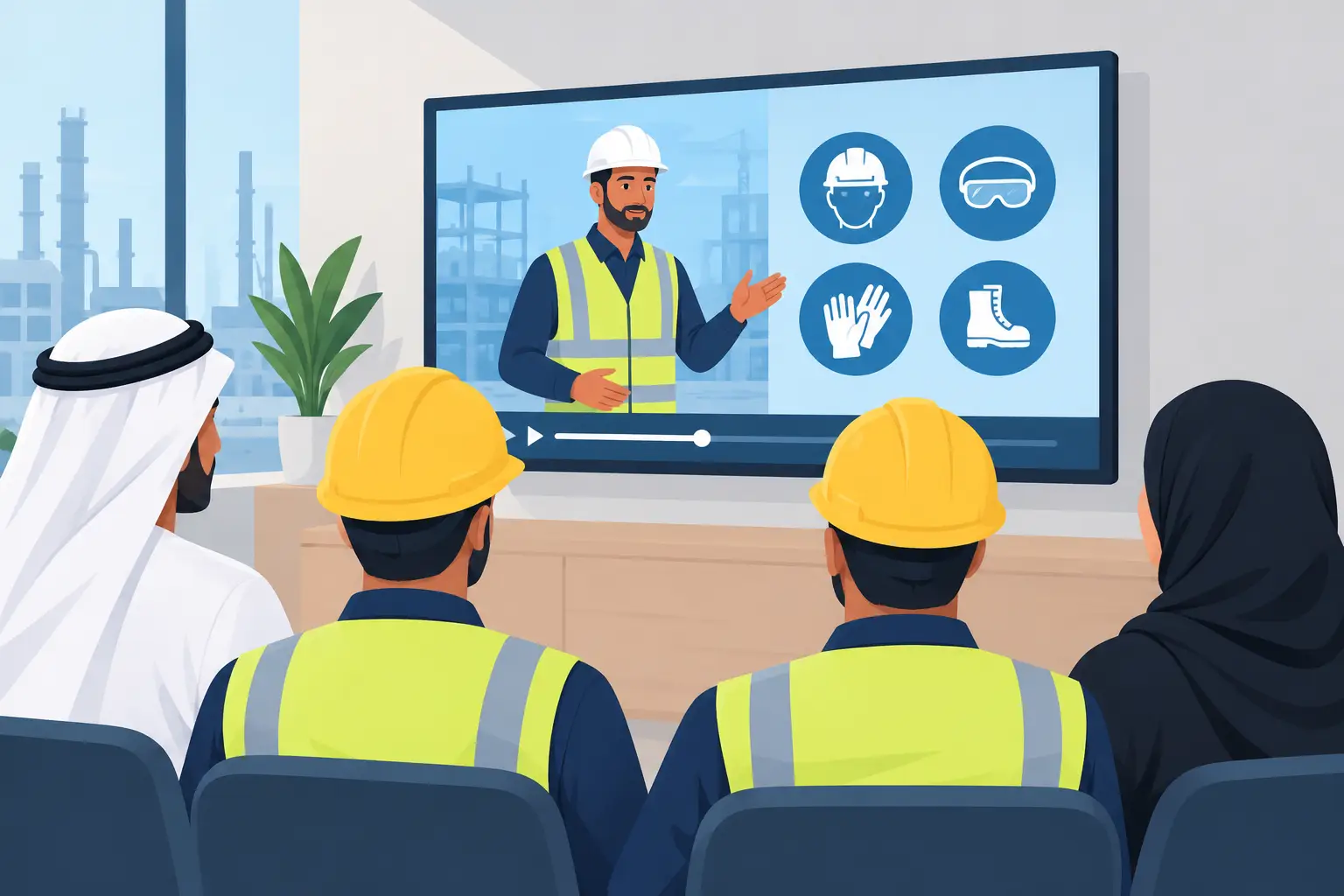
A worker is about to enter a confined space. The permit is ready. The supervisor has explained the controls. But the worker has only half understood the training video because it was delivered in a language that is not his strongest.
That is not a content problem. It is an operational risk. Arabic workplace safety videos help organizations communicate critical procedures in a language workers, supervisors, visitors, and local stakeholders can understand from the first viewing. When the message concerns lockout/tagout, PPE, vehicle movement, chemical handling, or emergency response, clarity is not a nice extra. It is part of the control.
Why Arabic workplace safety videos matter in Gulf operations
Across the UAE and wider Gulf region, many sites operate with multilingual teams. English is often the working language for procedures and documentation, while Arabic may be required for local employees, government-facing communication, site visitors, and client expectations. A single English-only safety video can leave gaps, even where the workforce has basic English proficiency.
Safety language is also different from conversational language. A worker may understand “wear your helmet” but miss the meaning of an exclusion zone, a permit condition, or a sequence for isolating energy. Under pressure, people do not have time to translate technical instructions in their heads. They need to recognize the hazard, understand the action, and know what to do if something changes.
Arabic video gives organizations a direct way to close that gap. It can explain the same approved procedure with Arabic narration, Arabic on-screen text, and visual demonstrations that make the instruction easier to retain. For many businesses, this is not about replacing English. It is about making the required message accessible in both languages without creating two different standards.
Translation is not enough
A safety script can be translated accurately and still fail as training. Literal wording, formal language, and dense on-screen text can turn an otherwise sound production into something workers watch without absorbing.
The better approach starts with the task itself. What does the worker need to notice? What action must happen before work begins? What is the one behavior that prevents the incident? Those questions should shape the script before recording Arabic narration.
For example, a video about forklift safety should not spend most of its running time defining terms. It should show the operator checking the vehicle, wearing the seat belt, observing speed limits, keeping forks low, stopping at blind corners, and separating pedestrians from moving equipment. Arabic narration should reinforce what appears on screen, not compete with it.
There is also a language decision to make. Modern Standard Arabic is generally appropriate for formal workplace training, particularly when the content is used across multiple Gulf markets. However, terminology should be reviewed by people who understand the sector and the audience. The wording used in a construction induction may differ from the language needed for a hospital, factory floor, or automotive workshop.
Build the video around the moment of risk
Long presentations are easy to commission and hard to use. They tend to combine every policy, every rule, and every exception into one recording that workers cannot recall on site. Safety has to be understood the first time, so the most effective videos are usually focused on a defined work activity or hazard.
A practical production process begins with the approved procedure, risk assessment, and site rules. Then it identifies the points where misunderstanding has real consequences. That might be the moment before a worker enters a restricted area, lifts a load, starts a machine, or responds to a spill.
Three things should be clear in every scene: the hazard, the required control, and the expected behavior. Done properly, this keeps the training direct without oversimplifying it.
Visual proof matters. If workers must inspect a harness, show the inspection. If they must establish a barricade, show the correct boundary. If they must report an unsafe condition, show who receives the report and what information is needed. Real locations and real work environments can make a message more credible, while animation can be the better choice for hazards that cannot safely be filmed or for processes that need a clean, consistent explanation.
Design for workers, not for a boardroom screen
A polished corporate film and an effective safety training video are not the same thing. Production quality still matters because poor sound, unclear graphics, or weak subtitles reduce attention and trust. But the purpose is comprehension, not decoration.
For frontline audiences, use plain language, short scenes, strong visual contrast, and a steady pace. Avoid placing key instructions only in small text. Avoid showing a worker doing something incorrectly without making the correction obvious. And avoid background music that competes with the Arabic voiceover.
Subtitles are useful, particularly in noisy environments or where a worker is more comfortable reading one language while listening to another. They are not a substitute for clear narration and visuals. The best combination depends on the workforce. A site with Arabic and English speakers may need both subtitle tracks. A broader induction may need Arabic, English, Hindi, and Malayalam versions from the same master production.
Consistency matters here. Each version must preserve the same safety standard, sequence, and approval status. Creating separate videos without a controlled master script can introduce subtle contradictions between languages.
Make understanding measurable
A completed video is not proof that training has worked. A worker can press play, leave the device unattended, or finish the video without understanding a critical instruction. For audits, incident investigations, and operational confidence, organizations need more than a viewing record.
A short assessment after the video can test the points that matter most. It should not be a vague memory test. It should confirm whether the learner knows the correct action in a real situation: which PPE is required, what to check before operating equipment, where to report a hazard, or when work must stop.
This is where role-based delivery becomes useful. A warehouse picker, a maintenance technician, and a site visitor do not need the same content or the same level of assessment. Assigning relevant Arabic safety modules by role keeps training time focused and prevents a general induction from becoming a long, forgettable session.
People Pulse Media uses PULSYON to make this process device-accessible and documented. The video trains. The assessment records whether the worker understood. Completion data, scores, and training records give HSE, HR, and compliance teams evidence they can retrieve when it is needed.
Where Arabic video delivers the most value
The strongest use cases are usually the ones where a missed instruction can immediately affect people, equipment, or compliance. Construction teams may need Arabic induction and work-at-height modules. Manufacturing operations may need machine guarding, chemical safety, and emergency response content. Healthcare and FMCG environments often need hygiene, infection control, and safe manual-handling training.
Arabic safety video also has value beyond the shop floor. It can support contractor onboarding, visitor orientation, driver safety, code-of-conduct communication, and incident-prevention campaigns. In each case, the format should match the job. A two-minute pre-task reminder serves a different purpose from a full onboarding module.
There is a trade-off. Shorter videos improve attention and make updates easier, but they cannot carry every detail in a complex procedure. Use video to explain the behavior and the reason behind it. Keep controlled documents, permits, toolbox talks, and supervisor briefings for the depth that certain high-risk work requires.
Start with one high-risk message
Organizations do not need to rebuild their entire training library at once. Start with a safety message that is frequently misunderstood, regularly repeated, or connected to a known incident trend. Review the existing procedure, identify what workers are missing, and produce one Arabic version that demonstrates the correct behavior clearly.
Then measure more than completions. Ask supervisors whether behavior is improving. Track common assessment errors. Review whether the content reduces repeat explanations during onboarding or toolbox talks. Update the video when equipment, layouts, or procedures change.
The best Arabic workplace safety videos do not make safety communication look better. They make the next safe action easier to understand and harder to miss.